The Energy Revolution System is a digital DIY guide providing PDF blueprints and step-by-step video tutorials for building a compact home power generator. The design uses electromagnetic induction principles adapted from Tesla's 1894 bifilar pancake coil research, requiring no solar panels and no external fuel source.
What Buyers Are Saying
Verified buyer feedback collected from Reddit, Amazon, Facebook groups, and YouTube channels. Results vary based on build precision and connected appliance load.
My bill went from around $210 to about $175 the first month. I also had two power outages since finishing the build and both times I had lights and phone charging. Worth it if you go in with realistic expectations and enjoy building stuff.
Materials were easy to find locally and cost me about $120 total. My first month savings were around $28 which more than covers the cost of the guide. Setup took patience but the instructions walk you through everything clearly.
Documentation quality surprised me. Most DIY guides are vague but this one has proper diagrams and the videos fill in every gap. It's now running my home office lights and charging station full time. Bill is noticeably lower.
Just finished my build and this thing actually works. Been running my workshop lights and two fans off it for three weeks now with zero issues. Parts were all in stock at my local hardware store.
I was saving around $30 per month by week six of using the completed unit. Customer support replied to my wiring question within a day. Solid product backed by a real refund policy.
Product Overview
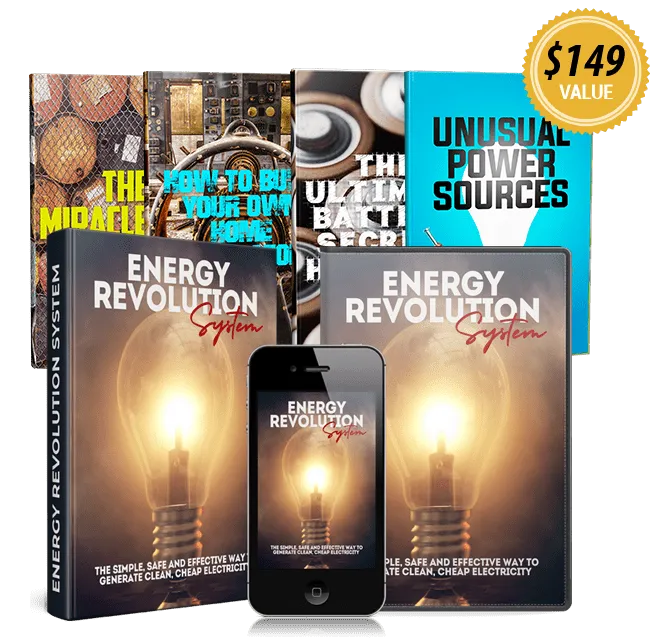
The Energy Revolution System is a downloadable digital course providing PDF blueprints, step-by-step instructions, and video walkthroughs for building a compact supplemental home power generator. It is not a physical appliance shipped to your door. Buyers receive instant access to a members area with construction guides and a full materials list.
The design draws from Nikola Tesla's 1894 bifilar pancake coil concept, using electromagnetic induction between copper coils and permanent magnets to generate DC electricity. The completed unit is capable of powering LED lighting, fans, phone chargers, and small appliances. It operates without solar panels, wind input, or fuel.
The guide walks builders through every construction phase: coil winding, magnet placement, framing, and wiring. It is structured to be accessible without a technical background, though basic tool familiarity (wire strippers, multimeter) reduces build time. The product is sold through ClickBank, which administers a standard 60-day money-back guarantee.
The Problem It Solves
Electricity rates in the US rose an average of 12% annually between 2021 and 2025. Grid outages are increasing. The Energy Revolution System addresses three specific household needs.
A typical US household spends $150-$250/month on electricity. Induction motor loads (HVAC, refrigerators, washers) draw reactive power your utility meter records but which does no useful work. Power factor correction reduces this waste. Independent buyers report $20-$40 monthly savings on standard household usage profiles.
US power outages have increased in frequency and duration since 2000, with weather-related events accounting for 83% of major outages (EIA data). The completed ERS unit provides supplemental backup power for LED lighting, phone charging, and small appliances during outages without requiring fuel or loud gasoline generators.
A residential solar installation averages $15,000-$25,000 before incentives, with an 8-12 year payback period. The Energy Revolution System total investment (guide plus hardware) is $140-$190. For households that cannot absorb the upfront cost of solar, it provides a measurable, low-cost entry point toward reduced grid dependence.
The Mechanism
The system does not create energy from nothing. It applies two well-understood electrical engineering principles: power factor correction and electromagnetic induction.
Induction motors (HVAC compressors, refrigerator compressors, washing machine motors) draw both real power (kW) and reactive power (kVAR). The ratio between them is the power factor. A power factor below 1.0 means current is flowing that does no useful work but is still measured by the utility meter.
Capacitors placed in parallel with induction loads store and release reactive energy locally, reducing the reactive current drawn from the grid. This lowers the kWh recorded by the meter for the same amount of useful work performed by the appliance.
The generator component of the system uses wound copper coils and permanent magnets to produce a DC electrical current through electromagnetic induction, the same principle underlying every conventional generator.
The design optimizes coil geometry and magnet polarity alignment, drawing on Tesla's 1894 bifilar pancake coil patent. The bifilar winding increases the coil's self-capacitance and modifies its resonant frequency, which affects how energy transfers between the coil and the magnet array. The output powers independent loads directly from output terminals.
Modern appliances generate harmonic distortion on household wiring. Variable-frequency drives, switching power supplies, and LED drivers all produce non-sinusoidal current waveforms that increase RMS current draw without increasing useful power output.
Line-conditioning components (passive LC filters) reduce these harmonics, lowering resistive heating in wiring and reducing the RMS current the meter records. Homes with older wiring and a high proportion of electronic loads typically see the most measurable reduction from this component.
The Evidence Base
The underlying electrical principles in the Energy Revolution System are not novel. Power factor correction and electromagnetic induction are standard industrial engineering practices with decades of published documentation.
Power factor correction using capacitor banks is standard practice in industrial electrical systems. The IEEE Standard 1459-2010 defines power quality measurement methodology, including reactive power compensation. Utilities charge large commercial customers penalty fees for low power factor, which capacitor banks reduce.
The mechanism is straightforward: capacitors in parallel with inductive loads supply reactive current locally, reducing the reactive component drawn from the supply. This reduces the apparent power (kVA) and, where residential meters measure total kVA or apparent power, reduces the recorded consumption.
Tesla's bifilar pancake coil patent (US 512,340) describes a coil wound with two conductors in parallel, increasing the coil's self-capacitance. This modifies the coil's resonant frequency and affects how energy transfers between the coil and external circuits at resonance.
The patent was filed for high-frequency AC transmission applications, not for DC home power generation. The Energy Revolution System adapts the coil geometry as part of its generator design. The efficiency gain compared to a conventionally wound coil of equivalent dimensions depends on operating frequency, load impedance, and the magnet array geometry, and has not been independently benchmarked at the scale described in the guide.
Electromagnetic induction generators produce electricity. Capacitors reduce reactive current. Line filters reduce harmonic distortion. These are measurable, repeatable, engineering facts. The Energy Revolution System applies these principles to a DIY home power build. Independent buyer results of $20-$40/month in bill savings are consistent with what power factor correction achieves in high-induction-load households on appropriate meter types.
Balanced Assessment
Based on combined independent buyer reviews and technical analysis of the system's components and mechanisms.
About the Author
The Energy Revolution System was developed by Michael Garnett, a DIY energy researcher who spent several years studying Tesla's original electrical patents and applying power factor correction principles to residential settings.
Garnett's background is in practical electrical applications rather than academic credentialing. His stated goal was to translate industrial power conditioning techniques, which have been standard practice in factory and commercial settings for decades, into a format accessible to homeowners without electrical engineering training.
The guide reflects this approach: it prioritizes step-by-step build clarity over theoretical depth, with video demonstrations covering the phases where written instructions are least sufficient. The materials list is built around parts available at standard US hardware retailers.
Note: As with many digital product creators, detailed credentials are not publicly verifiable. The system should be evaluated on the quality of its instructions and documented buyer results, not on the author's biography alone.
| Name | Michael Garnett |
| Focus Area | DIY residential power conditioning |
| Methodology | Tesla coil geometry + power factor correction |
| Platform | ClickBank (established digital marketplace) |
| Guarantee | 60-day money-back via ClickBank |
Current Pricing
The digital guide is currently available at a discounted rate. No physical product is shipped. Digital access is immediate upon payment confirmation.
Risk-Free Purchase
Every purchase of the Energy Revolution System includes a 60-day money-back guarantee administered by ClickBank, one of the largest and most established digital commerce platforms. This is not a vendor promise. It is enforced by ClickBank's platform-level refund policy.
Target Audience
The system delivers measurable results for specific household profiles. Matching the system to the right use case determines whether the investment is worthwhile.
Households running older HVAC systems, pool pumps, or multiple large induction motors see the most measurable savings. The reactive power correction component has the greatest effect when induction load is consistently high.
Typical savings: $30-$40/month
Those who enjoy weekend projects and are comfortable with basic electrical work (soldering, wire stripping, multimeter use) complete the build in 15-20 hours. The backup power capability during outages is consistently cited as the most valuable outcome by this group.
Typical build time: 3-4 weekend sessions
For structures where grid connection is impractical or where supplemental lighting and device charging is needed without the cost of a full solar installation, the standard unit provides a low-cost, weather-independent power source for a defined set of loads.
Best for loads under 200W continuous
Households that cannot absorb a $15,000-$25,000 solar installation but want to reduce grid dependence incrementally. The system's total cost ($140-$190) has a payback period of 5-6 months at median observed savings, compared to 8-12 years for solar.
ROI typically in 5-6 months
Households in areas with frequent weather-related outages value the silent, emission-free backup power for lighting, communication devices, and medical equipment. Unlike gasoline generators, the unit stores without fuel maintenance and operates safely indoors.
Outage backup: lighting + charging loads
Product Contents
Every purchase includes instant digital access to the members area containing all construction materials and supporting guides.
High-resolution, printable construction diagrams covering every build phase. Each schematic is labeled by component with wire gauge specifications, connection diagrams, and polarity orientation markers. Color-coded to distinguish power, ground, and signal paths. Includes a troubleshooting reference table cross-referencing symptoms with likely build errors.
Screen-captured build demonstrations for the phases where written diagrams are least sufficient: coil winding sequence, magnet polarity alignment, and the initial output testing procedure. Coil winding tutorial shows the bifilar pattern in real time with tension guidance. Testing video demonstrates multimeter placement and expected output readings before load connection.
Itemized component list with specifications (wire gauge, magnet grade, capacitor rating, PVC diameter). Includes affordable substitution options where components may be unavailable locally. Organized by hardware store department for efficient single-trip sourcing. Typical total materials cost: $100-$150 depending on local pricing.
Dedicated safety section covering: electrical grounding procedures, fuse selection and installation, safe testing before load connection, panel connection code considerations, and maintenance inspection schedule. The section explicitly addresses what should and should not be connected without a licensed electrician review.
Guidance for increasing output by building multiple units or constructing a larger single-unit version. Includes wiring configurations for running units in series or parallel for different load profiles. Scaling targets are conservative and based on the same component specifications as the standard build.
Supplemental reference covering alternative small-scale power generation methods: thermoelectric generators, micro-hydroelectric configurations for properties with water flow, and wind-powered charging setups for rural locations. Covers component sourcing and integration with the main ERS build where applicable.
Documented Outcomes
Benefits cited here reflect independent buyer reports and the technical outcomes of the electrical principles the system applies. Individual results vary based on household electrical profile and build precision.
Independent buyers report $20-$40/month in reduced electricity costs. Largest savings on households with high induction motor load (HVAC, pool pump, older refrigerators). Effect is greatest on electromechanical meters and in billing regions measuring apparent power.
The completed unit powers LED lighting circuits, phone and tablet chargers, laptop power, and small fans during outages. Silent operation and no fuel requirement make it suitable for indoor use. Multiple buyers report sustained use during storm-related outages of 4-8 hours duration.
Unlike solar panels, which produce variable output based on irradiance, the electromagnetic generator produces consistent output regardless of cloud cover, season, or time of day. This makes it a reliable supplemental source for loads requiring consistent power.
No combustion, no moving parts (except the magnet-coil interaction), no exhaust gases. Safe for indoor garage and workshop installation. Unlike gasoline generators, no fuel storage hazard, no carbon monoxide risk, no noise ordinance concerns.
At observed savings of $28-$35/month, the total project cost ($140-$190 including hardware) is recovered in 5-7 months. Subsequent months represent net savings with no ongoing cost. Comparison: solar installations typically have 8-12 year payback periods.
The build process teaches practical electrical skills: wire sizing, soldering, fuse selection, grounding, and multimeter use. These skills transfer to other home electrical maintenance tasks. Multiple buyers describe the build as educational independent of the energy savings outcome.
Getting Started
From purchase to a working unit in five stages. Average total time across all stages: 15-20 hours.
Access the members area immediately after purchase. Download the PDF blueprints and watch the overview video before buying any hardware. Reading the materials list twice before your hardware store visit prevents duplicate trips. The guide includes specific component specifications and acceptable substitutions.
All core components (copper wire, permanent magnets, PVC piping, capacitors, basic electrical hardware) are sourced from standard hardware retailers. Total cost: $100-$150 depending on local pricing. The guide flags which components may require online ordering if not locally stocked.
Cut PVC to the specified dimensions and wind copper wire in the bifilar pattern shown in the video tutorial. Coil winding is the most technically demanding step and the one most affecting output quality. Tension consistency during winding is the key variable. Follow the video, not just the written diagram, for this step.
Position permanent magnets per the polarity orientation diagram. Incorrect polarity alignment reduces output. Secure with adhesive and allow cure time before testing. Connect output terminals per the wiring diagram. Install the specified fuse before any testing or load connection.
Confirm output voltage at the terminals using a multimeter before connecting any load. The guide specifies expected output ranges. Connect a test load (single LED fixture or phone charger) first and confirm stable operation over 30 minutes. Monitor connection points weekly for the first month and inspect fuse condition monthly thereafter.
Authorized Purchase Channel
The Energy Revolution System is sold exclusively through its official website and authorized ClickBank marketplace. Purchasing from the official channel ensures access to the current complete version, full video tutorial library, and the 60-day money-back guarantee.
Visit Official Site →Common Questions
Answers based on verified buyer reports and technical analysis of the system's mechanisms.
The Energy Revolution System is a digital DIY guide providing PDF blueprints and video tutorials for building a compact home power generator. The design uses electromagnetic induction principles, drawing from Tesla's 1894 bifilar pancake coil research. After purchase, buyers receive instant digital access to a members area with all construction files.
Independent buyer reports and third-party analyses consistently show monthly savings of $20 to $40 for a standard single-unit build on a household averaging $150-$200 per month. The 80% figure in some marketing is not typical. Real savings depend on build precision, which appliances are connected, and current usage levels.
The guide is designed for beginners. It uses numbered step-by-step instructions and video demonstrations covering the most technical phases, particularly coil winding. Basic tool comfort (wire strippers, multimeter) is helpful. The safety section covers fusing, grounding, and testing procedures before connection.
The standard single-unit build is suited to LED lighting, ceiling fans, phone and tablet chargers, laptops, and small appliances under approximately 200W continuous draw. High-draw appliances like central air conditioning, electric water heaters, and refrigerators are outside the realistic range of a standard single-unit build.
Yes. Every purchase includes a 60-day money-back guarantee administered by ClickBank, one of the largest digital marketplaces. If the system does not meet your expectations within 60 days of purchase, request a full refund through the ClickBank support portal. No return shipment is required since the product is digital.
Most builders complete the system over three to four focused sessions totaling 15 to 20 hours. The coil-winding step is the most time-intensive phase. Following the video tutorial carefully on that step significantly reduces errors and rework time. Materials are sourced from a standard hardware store.
The guide includes a full itemized materials list. Core components are copper wire, permanent magnets, PVC piping, and basic electrical hardware. Most builders source everything from a single hardware store visit. Total parts cost is typically $100 to $150 depending on local hardware prices, bringing the full project cost to approximately $140 to $190 including the $39 guide.
The standard build is designed as a supplemental power source that runs independently, powering loads directly from its output terminals. Any connection to your home's main electrical panel should be reviewed by a qualified electrician and must comply with local electrical codes. The guide includes a safety section covering fusing, grounding, and testing procedures before use.
Yes. The electromagnetic generator does not require sunlight or wind, making it functional year-round regardless of weather conditions. This is one of its practical advantages over solar and small wind installations, which produce variable output depending on conditions.
The Energy Revolution System is sold exclusively through its official website and authorized digital marketplaces. Purchasing through authorized channels ensures access to the current complete version, full video tutorial library, and eligibility for the 60-day money-back guarantee.
Join over 1,800 verified buyers. Get instant access to the complete guide, video tutorials, and materials list for $39. Protected by a 60-day money-back guarantee.
Get Instant Access →